

Overview
The Transfer to phone number action lets your AI Agent hand off a live phone call to a human. When the action is triggered, Chatbase plays a configurable hand-off message to the caller and transfers the call to the phone number you’ve configured.Best for:
Getting a caller to the right person on the phone (sales, billing, or support) when the AI Agent can’t resolve the call itself.
- “Can I speak to a real person?”
- “Put me through to billing”
- “I need to talk to someone about my account”
How it works
1
The AI decides a transfer is needed
The AI Agent determines that a human should handle the conversation, based on the instructions you’ve provided in the When to use field.
2
The caller hears the hand-off message
Chatbase automatically plays your configured Message to caller before initiating the transfer.
3
The call is transferred
The live call is forwarded to the configured phone number.
4
Transfer complete
Once the transfer begins, the AI Agent leaves the call and cannot resume the conversation.
How to create the action
1
Navigate to Actions
Go to your Chatbase dashboard and select your agent. Click Build > Actions in the left sidebar.
2
Create the Action
Click Create action, then select Transfer to phone number.
3
Configure General Settings
Action Name: A descriptive name for the action, such as
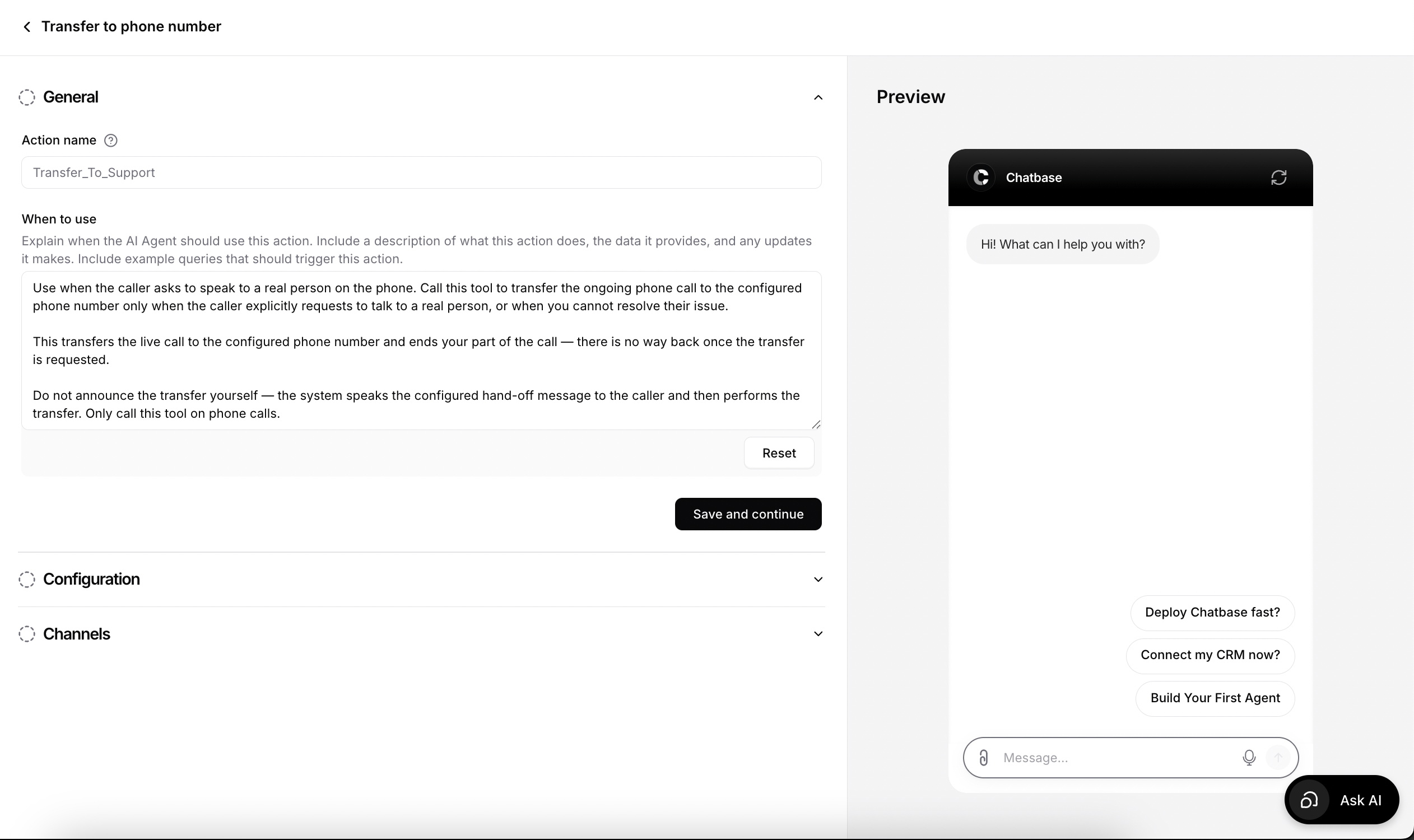
Transfer_To_Support. If you have multiple departments, create multiple transfer actions: Transfer_To_Sales, Transfer_To_Support, Transfer_To_Billing.When to use: Describe exactly when the AI should perform the transfer. See Examples below.To restrict the action to procedure steps only, turn on Only use in procedures. When it’s on, the When to use field is hidden, because the agent no longer decides when to call the action.4
Configure the transfer
Set the destination number and the messages the caller hears. See Settings below.
5
Choose Channels
This action supports the Phone channel. Click Setup next to Phone to configure the required phone integration.
6
Enable and Test
Click Save & enable, then place a test call.
Settings
Phone number: The number that should receive transferred calls. It must use E.164 format, for example+12125551234.
Only the following are supported:
- Twilio phone numbers
- SIP trunks
If you’re using a SIP trunk, make sure both SIP REFER and PSTN are enabled on the trunk before using this action. Otherwise, call transfers will not work.
If the transfer fails, the AI Agent says this message and continues assisting the caller. If this field is left empty, the default failure message is used.
Test the action by placing a call and asking to speak to a person. The caller should hear your hand-off message, and the call should arrive at the configured number.
Examples
A When to use description that defines the trigger and tells the agent not to narrate the transfer itself:Limitations
- Once a transfer begins, the AI Agent cannot resume the conversation.
- Only Twilio numbers and SIP trunks are supported as transfer destinations.
- SIP trunks need SIP REFER and PSTN enabled, or transfers fail.
Best Practices
Be Explicit
Clearly define when the AI should transfer the caller instead of trying to solve the issue itself.
Use Descriptive Names
If you have multiple transfer actions, give each one a meaningful name like Transfer_To_Sales or Transfer_To_Billing.
Write a Natural Hand-off Message
Keep the message short so callers know they’re being connected.
Configure a Fallback
Always provide a friendly fallback message in case the transfer cannot be completed.